What performance tests are required for wet clutch friction plates?
Wet clutch friction discs constitute the core component within the clutch system, with their performance directly influencing gearshift smoothness, power transmission efficiency, durability, and reliability. To ensure compliance with design specifications and service life requirements, a series of rigorous performance tests must be conducted. The principal tests encompass the following major categories:
1. Friction Performance Testing This constitutes the most critical test category, directly impacting the clutch's torque transmission capacity and control characteristics. Dynamic Friction Coefficient Testing: Measures the clutch's ability to transmit torque under slippage conditions. This forms the basis for designing clutch capacity and calculating thermal loads. μ-v Characteristics: Tests variations in dynamic friction coefficient across different relative slip speeds. The ideal behaviour is for the coefficient to decrease slightly or remain stable with increasing speed, avoiding negative slopes (which may cause judder/chatter). μ-p Characteristics: Tests the dynamic friction coefficient variation under different clamping forces. μ-T Characteristics: Tests the dynamic friction coefficient variation at different oil temperatures. Focus on stability at elevated temperatures (resistance to thermal fade). Static friction coefficient testing: Measures the friction coefficient at the instant slip commences from a fully stationary state. Excessively high static friction coefficients may cause start-up shock. Friction stability testing: Monitors friction coefficient variation and stability during prolonged slip or high-energy input conditions to evaluate thermal fade resistance. Friction hysteresis/recovery characteristics: Evaluate the speed and extent of friction performance recovery after the clutch experiences high-temperature slippage. Stick-slip characteristics: Assess the tendency for stick-slip phenomena (vibration) to occur at extremely low slippage speeds.
2. Durability and Wear Performance Testing simulates repeated engagement and disengagement under actual operating conditions to evaluate service life and reliability. Accelerated Life Testing: Repeated engagement-disengagement cycles are performed under specified operating conditions (pressure, rotational speed, sliding friction coefficient, oil temperature, cycle count/duration). Performance Degradation Monitoring: Changes in friction coefficient, wear volume, and other parameters are measured during or after life testing. Failure Mode Analysis: Observe whether friction linings exhibit failure phenomena such as material spalling, warping, ablation, cracking, or adhesion. Wear Measurement: Precisely measure changes in friction lining thickness before and after endurance testing (typically averaged from multiple measurement points). Thermal Shock Testing: Simulates extreme conditions (e.g., sudden disengagement and cooling after high-energy engagement) to evaluate material resistance to thermal cracking and deformation.
3. Thermal Performance Testing The heat generated by wet clutch friction is a critical factor affecting performance and service life. Thermal Fading Test: Measures the extent to which the coefficient of friction decreases with rising temperature under continuous high-load slipping conditions. Thermal Recovery Test: Measures the extent and rate of coefficient of friction recovery after thermal fading, under reduced load or idle conditions. Thermal Conductivity Testing: Assesses the friction material's inherent ability to conduct heat (rarely tested directly, but considered during material design). Specific Heat Capacity Testing: Evaluates the friction material's capacity to absorb heat (rarely tested directly, but considered during material design). Thermal Expansion Coefficient Testing: Measures the extent to which the friction material expands with increasing temperature, affecting clutch clearance and engagement characteristics.
4. Mechanical property testing evaluates the strength and stability of friction linings under mechanical loads. Compressive strength/compression set testing: Measures material deformation under high pressure (at ambient and elevated temperatures). Flatness/warpage testing: Assesses surface evenness to ensure smooth engagement. Tensile Strength/Interlaminar Bond Strength Test: For friction linings with backing plates (steel cores), assesses the bond strength between the friction material and backing plate (at ambient and elevated temperatures post-heating). Shear Strength Test: Evaluates the friction material's inherent resistance to shear forces. Burst Strength Test: For friction linings incorporating oil grooves or oil holes, tests structural integrity under high-pressure oil loading.
5. Physical and chemical property testing evaluates the inherent characteristics of the material and its compatibility with lubricants. Density/porosity testing: Influences oil storage, flow, and friction properties. Hardness testing: Assesses surface wear resistance and scratch resistance of the material. Lubricant compatibility testing: Evaluates the impact of friction material on the physicochemical properties of automatic transmission fluid (e.g., viscosity, acid value, friction characteristics), as well as the effect of oil degradation products on friction material performance. Static immersion test: Observes whether the friction material exhibits swelling, deformation, or material leaching after prolonged immersion in oil. Dynamic oil influence test: Monitors changes in oil properties (e.g., acid value) during friction testing. Material composition analysis: Analyses the composition and microstructure of friction materials using techniques such as spectroscopy and electron microscopy.
Key Considerations for Testing Standards: Tests typically adhere to industry standards (e.g., SAE J2490, J2487) or specific specifications from original equipment manufacturers (OEMs). Testing Equipment: Primarily conducted on clutch inertia test benches or SAE No.2 test machines, enabling precise control of pressure, rotational speed, inertia, oil temperature, and flow rate. Test Conditions: Test parameters (pressure, speed, temperature, friction work, cooling conditions) must cover or simulate the most severe operating conditions encountered in practical applications. Sample Quantity: To ensure result reliability, multiple samples are typically tested. In summary, evaluating the performance of wet clutch friction linings constitutes a systematic engineering endeavour. It necessitates a comprehensive assessment of multiple factors, including friction characteristics, wear resistance, thermal stability, mechanical strength, and compatibility with lubricants. These test data form the critical basis for optimising clutch design, ensuring vehicle shift quality, and guaranteeing the reliability of the transmission system.
Need Certified Wet Clutch Friction Discs That Pass Rigorous OEM Tests?
Access performance reports and custom solutions engineered for durability & thermal stability.
Contact Our Engineering Team for Technical Consultation
+86-13584713740

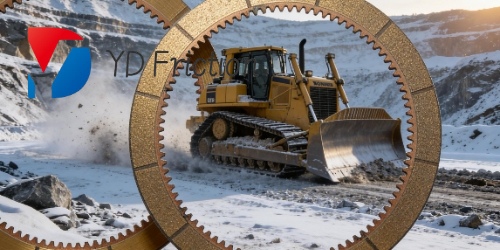 High-Performance Friction Discs for Komatsu Equipment: D155, D355, and PC Series Solutions
 High-Energy Friction Discs for Caterpillar (CAT) Equipment: D6, D8, D10 and 966, 988 Series
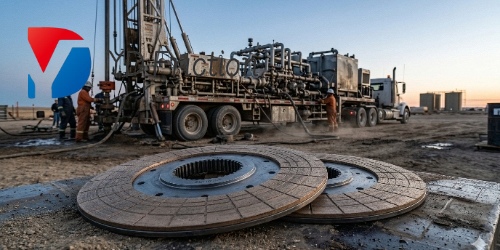 High-Performance Friction Discs for Allison Transmissions: Solutions for 4500, 5000, and 9000 Series
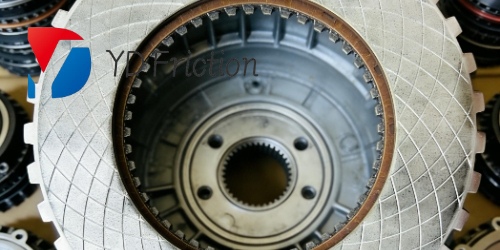 High-Performance Friction Discs for ZF Transmissions: Technical Guide for WG180, WG200 & 4WG210 Series